
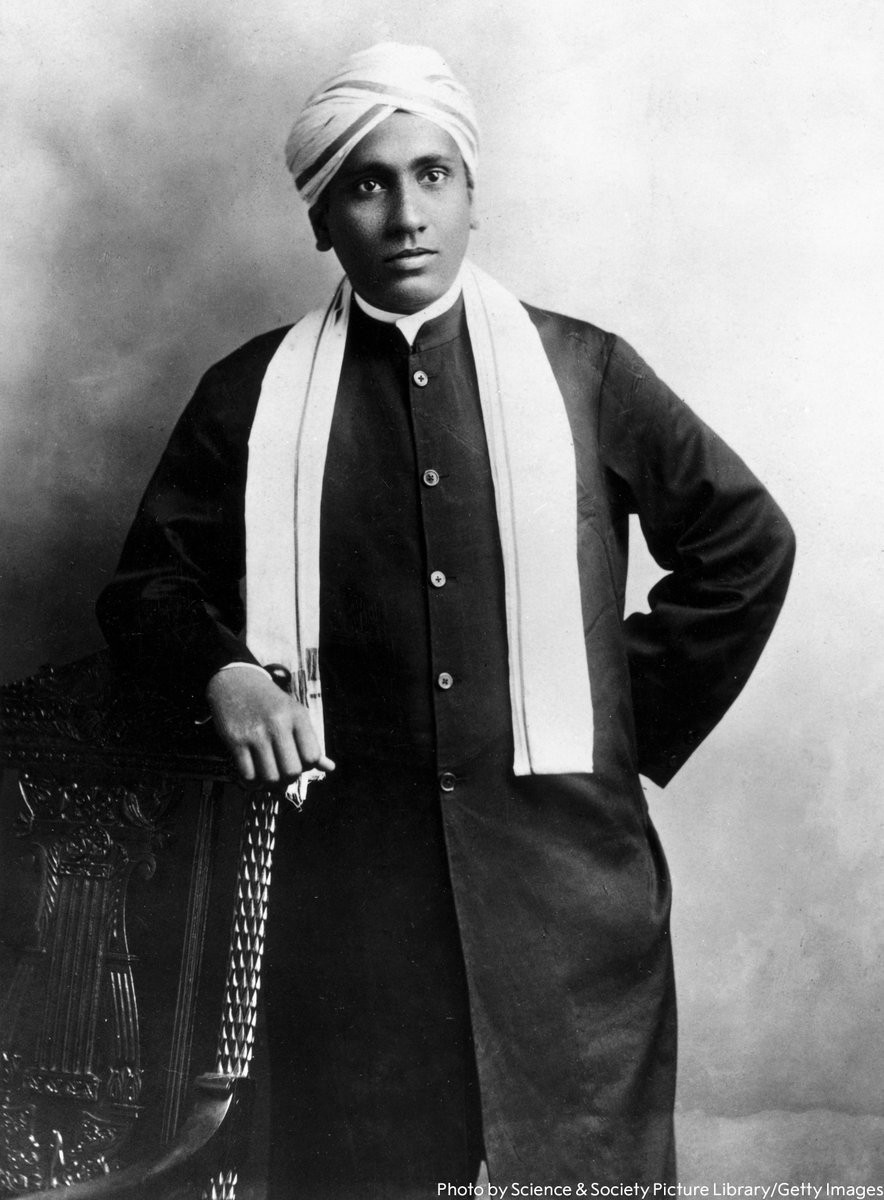
Sir Chandrasekhara Venkata Raman was one of India’s greatest scientists and a pioneer of modern physics. He is best known for the discovery of the Raman Effect, which explains how light interacts with matter..
In recognition of this groundbreaking discovery, he was awarded the Nobel Prize in Physics in 1930, becoming the first Indian to receive a Nobel Prize in the sciences.
C. V. Raman was born on 7 November 1888 in Trichinopoly (now Tiruchirappalli), Tamil Nadu. A brilliant student from an early age, he completed his schooling early and pursued higher education at Presidency College, Madras (now Chennai).
He earned both his Bachelor’s and Master’s degrees in Physics and published his first international research paper while still a student.
“ The essence of science is independent thinking and hard work. ”
Raman initially joined the Indian Finance Service but continued scientific research alongside his official duties. His passion for science led him to pursue full-time research and teaching at the University of Calcutta.
C. V. Raman played a key role in shaping scientific research in India. He founded the Indian Academy of Sciences and the Raman Research Institute, mentoring generations of scientists.
In his honor, 28 February is celebrated as National Science Day in India.
Born: 7 November 1888
Died: 21 November 1970
Field: Physics
Known For: Raman Effect